Funtown: A Have/Have Not Story

It’s been pretty warm lately, so yesterday we decided to take the boys to the park. We loaded up some snacks and some soccer balls and made our way to Micke Grove Park, where we played and played all morning and had a great time. It really is a nice park.

The park also has a zoo. And next to the zoo is Funtown. Funtown is a mini amusement park. A park within the park.

I remember going to Funtown when I was a kid. I remember it being fun. And being excited to go there. My kids were excited, too. And they had fun. But, as an adult, Funtown was…interesting.

Funtown resembles sort of a post-apocalyptic amusement park. Like, if, say, seventy percent of the population died in a plague, and afterwards there were still amusement parks, the amusement parks would be like this.

Or, if you’re familiar with George Saunders stories, Funtown is like an amusement park in a George Saunders story.

Micke Grove Park, and everything in it, including Funtown, is operated by the county’s Parks and Rec Department, and, when compared to, say, an amusement park that is not funded by a county but rather by a megacorporation, like, say, Disneyland, Funtown is a vivid demonstration of the haves and have-nots.

We were the first to arrive. Funtown had two employees. Later we would learn that there were three employees, but one was running late. One of the employees was a nice lady who sold us tickets. The other employee was a youngster, as was the employee who would arrive late. The youngsters were nice, too.

As we were buying tickets, Liz and I saw on a sign that Funtown had mini-golf. We’d been talking about taking the boys to play mini-golf, but the nice lady informed us that the mini-golf course was currently closed. They were having a problem with some geese.

“Geese?”

“Yeah, a bunch of geese took it over. So it’s not safe. But we think we can get it open again this weekend.”

Here’s a picture of the mini-golf course. You can’t see any geese, but you can imagine them, hiding out, ready to strike.20180330_113719

There are about nine rides at Funtown. They’re fairly typical rides: tilt-a-whirl, roller coaster, carousel, etc. But the challenge, for a Funtown employee, given that there are nine rides (plus a ticket booth, and a concession stand) but only three employees (and one is late) is that if some family is hanging around a ride looking like they want to ride it, then one employee has to drop whatever they were doing and go operate that ride.

Our first ride was the fish. It’s fish that go around an octopus, which the kids thought was great.

20180330_112320

But about the time we finished with the fish, two more families arrived, which made it much more complicated for the two employees. Luckily the second youngster showed up, late, but then a fourth family showed up, too, and someone needed to sell them tickets.

So we and one of the other families decided to sort of stick together, ride-wise, to make it easier.

Next was cars. Cars that go around and around. First Tom tried to pick this purple car, but, as indicated by the caution tape and the sign, it was unavailable.

20180330_112812

The sign says: “This car is down (sad face). Don’t ride me.” A pedantic English teacher might point out that the point of view of this sign is inconsistent.

The tilt-a-whirl, nearby, was in a similar situation: at least one tilty-car had an Out of Order sign taped to it (but no caution tape).

20180330_113104

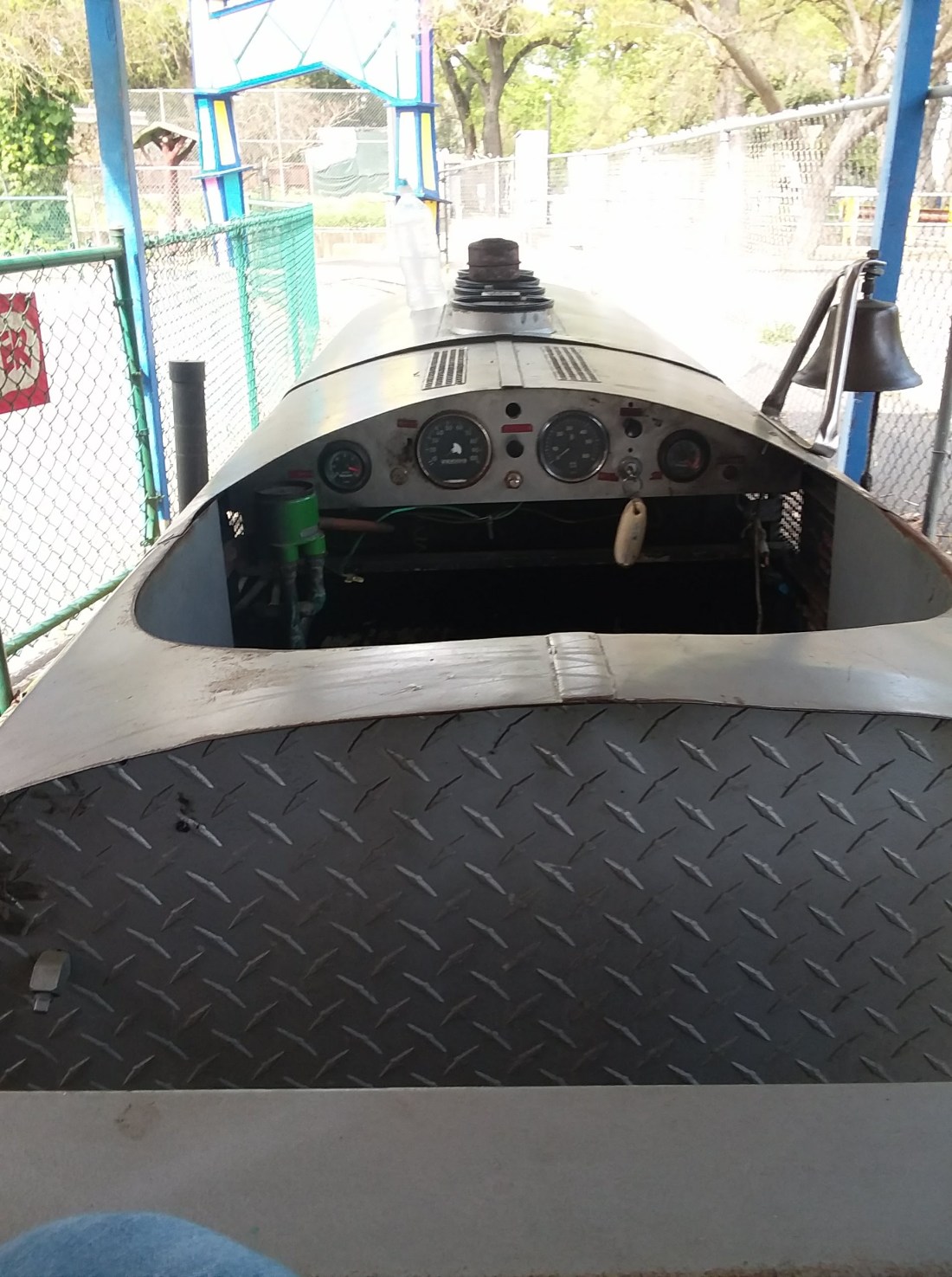
Then we went for the train ride. It’s a little train that runs all around the perimeter of the park. We sat in the first car, right behind the engine. The instrument panel reminded me of the 1958 Cessna Luscombe my grandfather used to take me flying in when I was little.
20180330_113241

Once the passengers were all loaded, before departing, the youngster reached under the driver’s seat and pulled out a hammer. Then he crawled under the engine and banged on something a few times. Then he got up and looked at me and said, “I have to do that to start it.”

After a few tries, it started right up, and we were off.

Here’re three pictures. One picture is of the youngster banging with the hammer, another is of Liz watching the youngster bang on the engine that will next transport her entire family around the park, and the third picture is of the youngster driving the train.

And here are pictures of Tom and Sam, delighted with the train ride:

The train ride included a view of the bathroom, which you get to by going out the back gate, past the dumpster, and this fenced off area where they collect all of the broken Funtown stuff:

The train also passed the roller coaster, the theme of which is Giraffe, or perhaps Safari, and these two guys, who were working on The Scrambler, seemingly trying to figure out what was wrong with it (we didn’t ride The Scrambler):

We would encounter these two guys again later, at this airplane thing that Sam rode:

20180330_115800

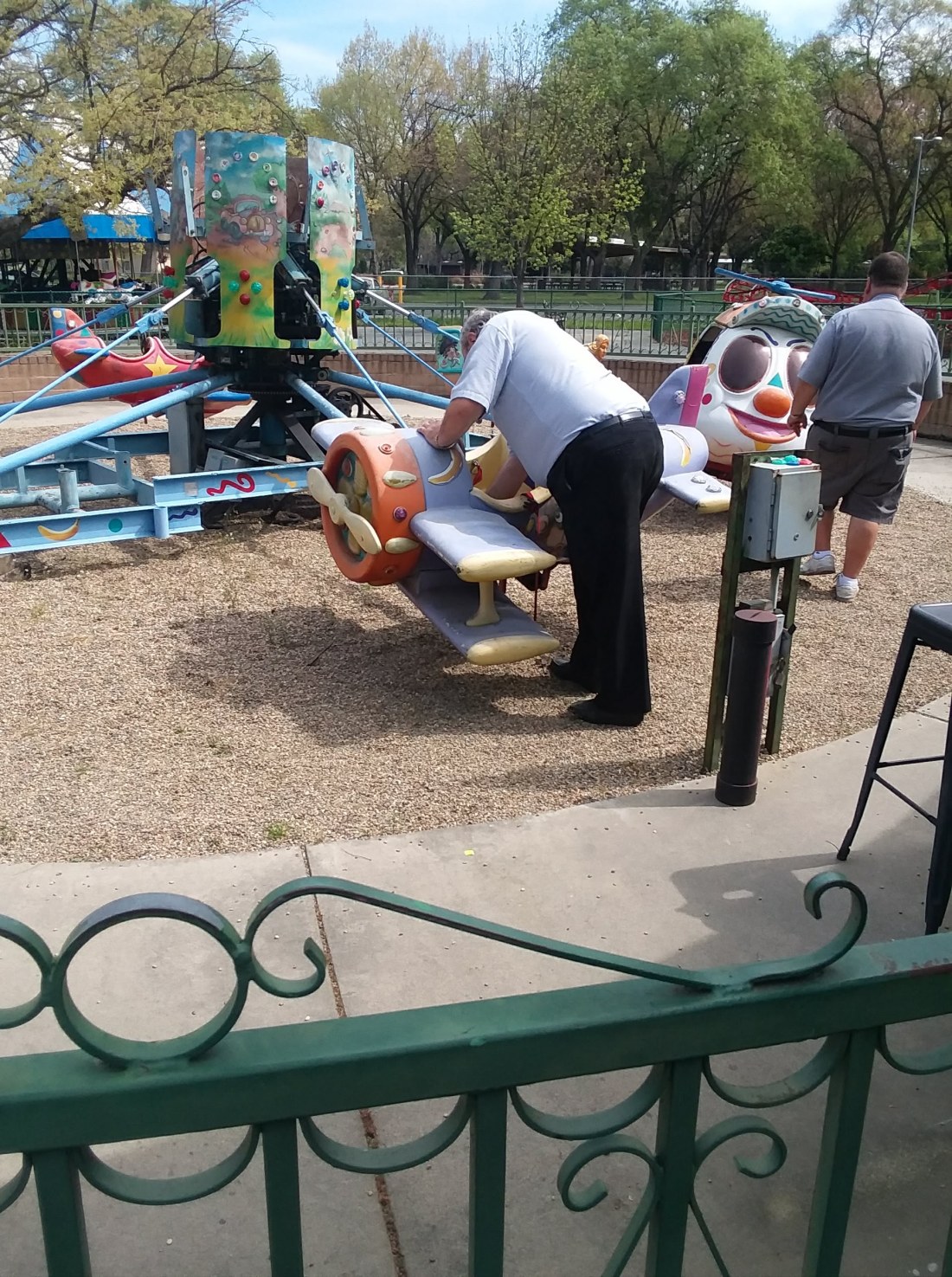
During the ride, Liz overheard the guys talking. It turns out one guy was a (the?) manager, and the other guy was an inspector. The manager guy told the inspector guy that they could only afford to re-paint one or two rides a year. The planes were due for some paint.

As soon as Sam got off, the guys swooped in. They had been watching closely, and something apparently didn’t look right:
20180330_115928

Here’s the thing: when you go to Disneyland, the employees are all very nice and helpful. They seem, genuinely, to want you to have a good time.

But the employees at Funtown, all three of them, were also very nice and helpful. And they also seemed, genuinely, to have wanted our boys to have a good time (which they did; they talked about it all afternoon).

The difference is, the nice and helpful Disneyland employees have a lot more to work with. They know they have a good product, backed by a corporate machine (as opposed to a parks and rec department). The nice and helpful Disneyland employees don’t have to crawl under the train and bang it with a hammer. They don’t have to hand-crank the roller coaster to get it going. And they generally don’t have to battle geese for territory.
Borges at Disneyland

I read a lot of Borges.

My critical thesis in grad school was on Borges’s influence on the fiction of John Barth.

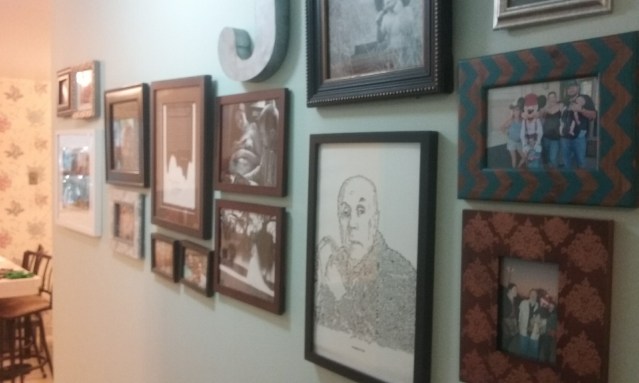
There’s a framed illustration of Borges in the hallway of my house, surrounded by pictures of my family. The Borges picture is bigger than the other pictures.

See:

20160907_162906

In Borges’s fiction, there is a finite number of possibilities–a finite number of things that can happen to an individual–so what separates, or sets apart, each individual is the particular things that happen to each of them, and to Borges these particulars are limited by time, so that if everyone was immortal, then all things would happen to all people, and all people would therefore become one person. Each individual, for instance, would at some point write Hamlet, so each individual would be Shakespeare (or would have lived the particular events of Shakespeare’s life), but each individual would also be Justin Bieber, having also lived the life of Justin Bieber.

Because of this worldview, characters in Borges’s stories (for example: The Immortal, Shakespeare’s Memory, Borges and I) often blend into one another (or, to put it another way, using Borges’s common motif of the mirror: characters become reflections of one another).

And that’s what I kept thinking about when we took our kids to Disneyland.

Everywhere I looked, I saw a reflection of myself (or, to put it another way: everywhere I looked, I saw my own life being lived by hundreds and hundreds of other men).

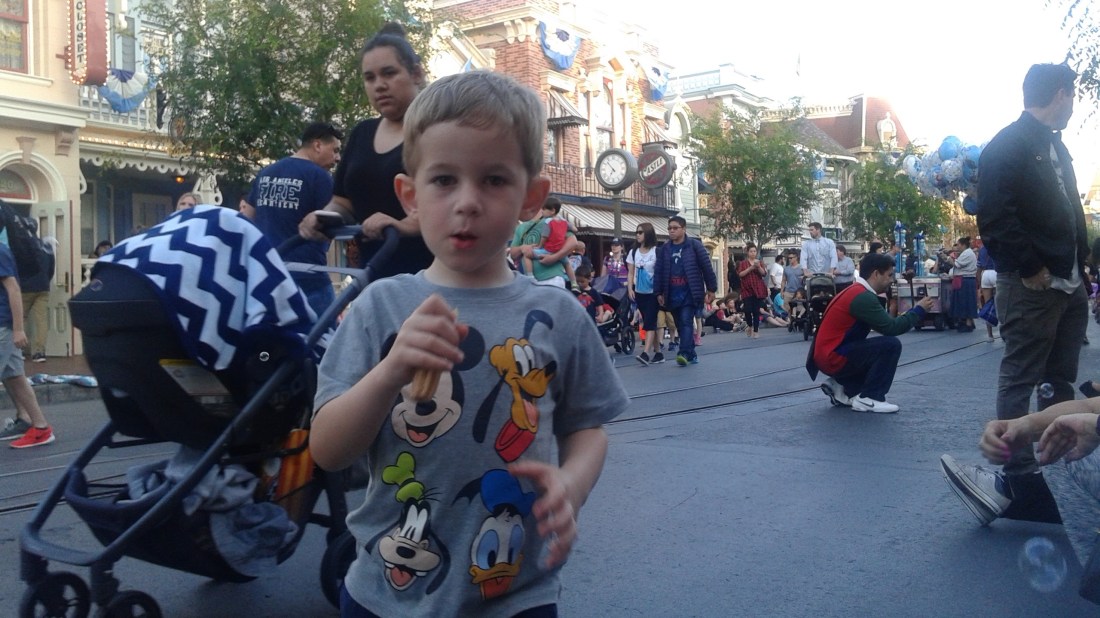
For example, here’s a picture of my kid eating a churro. I’m not in the picture, but there’re at least four other versions of me that are in the picture. Can you spot them?

20160511_185241

And, of course, it’s not just me. The lives of my wife and of my kids are repeated over and over, as well. Some of those repeats are in this picture, too.

Take, for another instance, the picture above of Borges in my hallway. Next to Borges is a (much smaller) picture of me and my wife and my mother and my kids with Mickey Mouse. What the picture does not show is that we had waited in a long line of families (dozens of families) all of whom took that same picture, and that same long line had formed dozens of times over the course of that day, as it did and as it will do on all other days, including today, such that thousands of thousands (millions?) of families have the same picture with Mickey Mouse hanging on their wall (though probably not next to a picture of Borges).

So we are all at the same place having an individual experience that thousands of other people are also having on the same day and that thousands and thousands (millions!) of other people also have had or will have on each day prior and each day after the day that we had it.

Yet: it’s an incredibly individual and magical experience. Or at least Day One is magical.

Most of the people who are on that day living the same life as you are living either Day One or Day Two (for some, there is also a Day Three, but for almost all, there is Day One and Day Two).

And because you are at Disneyland and not at California Adventure, then you and most of the other people who are also living your life (specifically, the ones with strollers and giant, over-stuffed diaper bags) are living Day One.

All of you individually planned a trip, and all of you are on Day One of that trip. Day One is Disneyland. Day Two is California Adventure. If there’s a Day Three, it’s back at Disneyland (which means that, everyone who is living Day One will encounter some people who are living Day Three, but it’s easy to tell the people living Day Three from the people living Day One: the people living Day Three are the people who look like they are trying to recreate the magic of Day One, quickly, before driving home, but failing).

It was pretty much the same when I was a kid, except that Day Two was Knot’s Berry Farm, or later Universal Studios, because when I was a kid California Adventure was the parking lot.

Anyway, Day One is magical. For everyone, but especially the kids. And the kids don’t know and probably wouldn’t care if they did know that thousands of other kids who are living an alternate version of the same life are also having an independently magical experience. Each of the dozens of kids who are lined up to meet Princess Aurora has the individual and magical experience of meeting Princess Aurora, and that experience is unaffected by its repetition for dozens in front and dozens behind (plus hundreds and thousands and millions who have done and will do the same on a day that at Disneyland always looks the same and that repeats itself into infinity)

20160511_104638.

About Day Two:

Day Two is pretty awesome, but perhaps less magical. Day Two is about strategy and efficiency. Everyone living Day Two has lived the magic of Day One and is now going to get their money’s worth, because this s-word is expensive.

Day Two begins at the rope line. Everyone living Day Two has read on Pinterest that they need to get there (to California Adventure, where, as mentioned, Day Two is lived) before it opens and to line up at the rope line.

Some people who are living Day Two have read on Pinterest that as soon as the rope drops they need to speed walk straight to the line for the Cars Fast Pass.

Other people are living a version of Day Two in which the thing to do is to speed walk past the Fast Pass line and directly to the Cars ride itself.

A few people are living a version in which the thing to do is to go do something else other than Cars precisely because everyone else who is living Day Two is going straight for Cars, but this way of living Day Two basically means foregoing Cars altogether, and Cars is pretty awesome.

We lived the version of Day Two in which we went straight to the line for Cars. It was pretty awesome. We were glad we lived this version because the people who lived the version of Day Two in which they got into the line for the Cars Fast Pass had to wait a long time for that Fast Pass, and the Fast Passes were mostly for late that afternoon, and pretty soon they were gone altogether.

Anyway: everyone who is living Day Two has a strategy with which to conquer Day Two, most of those strategies meant to outsmart everyone else who is also living Day Two and who have the same or similar strategies.

The rest of Day Two is basically a contest to see who in the family first gets to the point that they’ve had so much fun they could kill someone.

And then the next yous arrive and you go home.