Invasion of the Furniture Risers

There are fourteen individual furniture risers in my house at the moment—of three different types.  Forty-eight hours ago, there were zero.

This all started on Friday, when Liz and I began to put together the baby’s room, which previous to Friday had been a guest bedroom.

Here’s a picture of the room Friday morning:
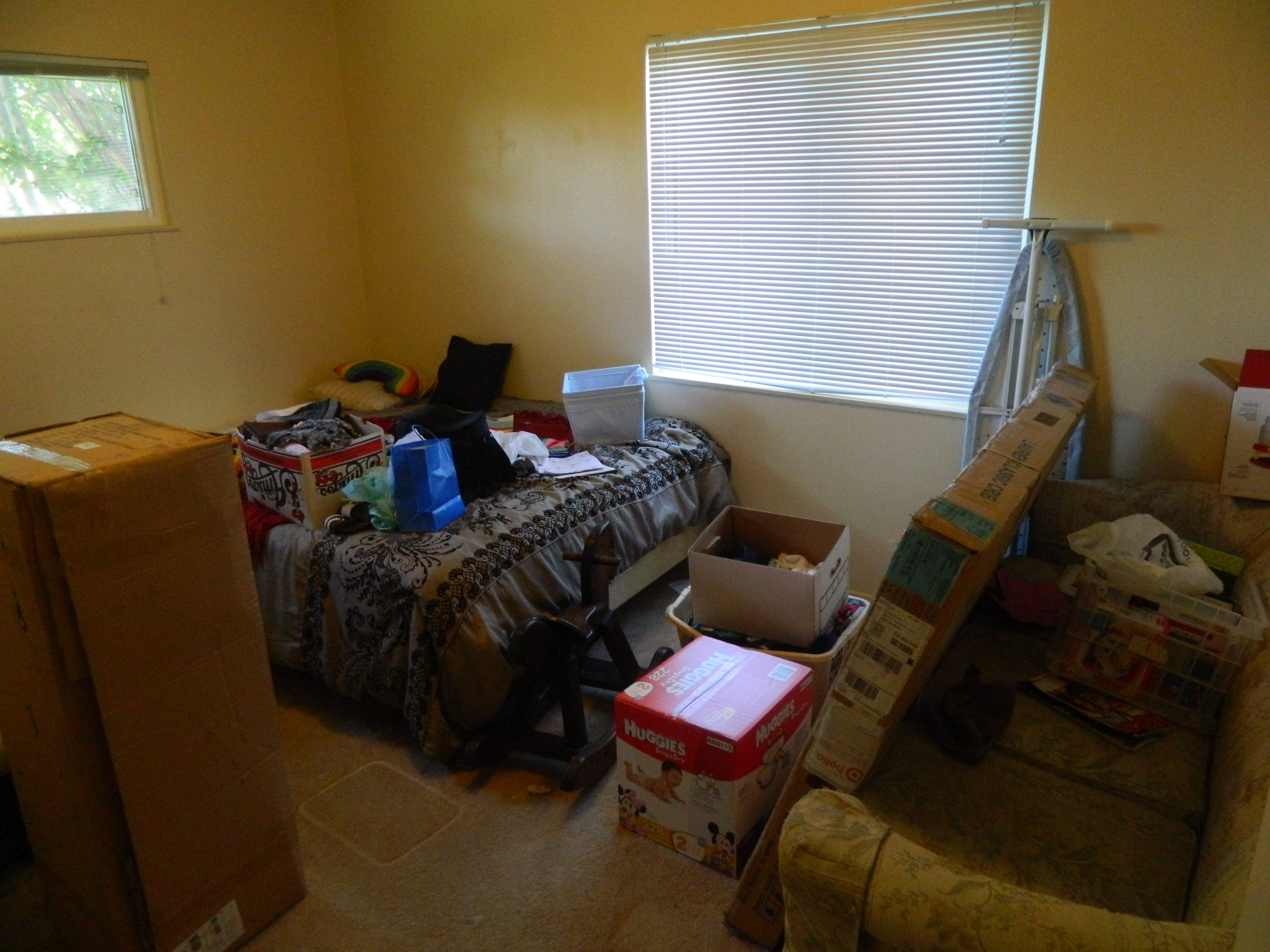
Here’s a picture of the room now:

Notice the ironing board didn’t move.

My job Friday was to assemble the two major pieces of furniture that we have thus far purchased: the crib and a dresser that we had hoped could double as a changing table.

The crib turned out perfectly nice, as did the dresser, though in the case of the latter it became apparent during the course of its assemblage that it was not quite as large as we had imagined based upon the context-less picture provided on Amazon.  If the picture had included, say, a watermelon sitting on top of the dresser, or a rabbit, we would have realized that the dresser was closer to knee-high than hip-high, with the accompanying discrepancies in regards to proportion.  In other words, the dresser would be a dresser, but it wasn’t going to also be a changing table.

This seemed acceptable to me, but Liz, who made frequent worried checks as the dresser began to take form, hoping that upon leaving the room and returning the item would hit a growth spurt, felt that she had failed as a home-shopper, and thereby as a wife and mother and human being, and that she needed to find a way to fix her mistake and redeem herself, resulting in an almost immediate trip to Home Depot to purchase the following:

Little furniture riser disk things, which, when stacked and placed under the dresser’s legs, raised the dresser several inches, but failed, as I pointed out, to expand the proportions of the item in question, leaving the top surface still far too narrow to serve as a changing table.

The issue rested until that afternoon, when Liz declared her intentions to do some shopping at Ross and Marshall’s, a trip she returned from with the usual Ross and Marshall’s fare, along with a set of four zebra-striped furniture risers (these significantly taller than the little disks) seen here:
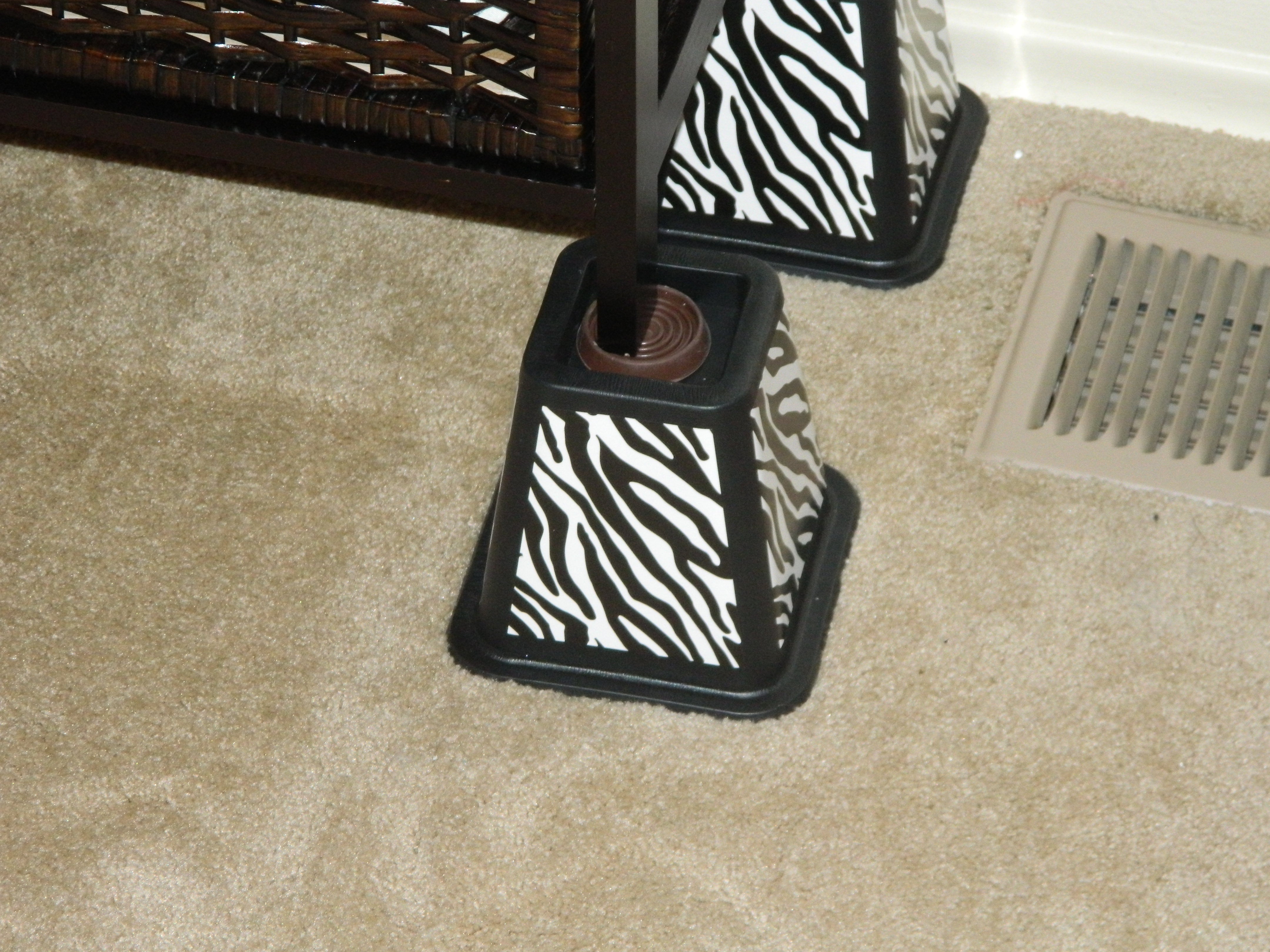
These newer, much more decorative risers did indeed raise the dresser even higher, though, as I again pointed out, failed to make the necessary alterations to its proportions necessary for its use as a changing table.

Liz’s desperation came from the fact that her spending whatever-the-dresser-cost (which was not much) was predicated on its serving as both dresser and changing table, and if it came to serve only as dresser, she has wasted money.

The extent of this desperation became apparent Saturday morning, as we conducted an impromptu yard sale to liquidate some of the furniture we had removed from the guest-room-now-baby-room.  A van pulled up to the front of the house and a young man crossed the front lawn to hand over a box.  The box was labeled Amazon, and upon opening it with my keys I found it to contain this:

A set of four furniture risers, quite similar to the previous set, but without zebra stripes.

In fit of nervous laughter, Liz admitted that she had ordered the just-delivered set shortly before her trip to Ross, where she purchased the zebra stripe set.  She reportedly just couldn’t wait.

When the nervous laughter, now emanating from both of us, finally died down, I suggested that Liz write a short story about a woman that keeps buying more and more furniture risers.  She starts with a dresser, or something, that she wishes was taller, then the chair next to the dresser, then the kitchen table, and the dining room table, and the cat box, and then it would get sort of Barthelmeean, or something, or like magical realism, and the woman would put furniture risers beneath every piece of furniture and appliance, including the refrigerator, and then beneath her pets, and her spouse and children, and the house itself, and then her neighbors, everyone but her, and her neighbor’s houses, and the White House, and beneath the President and his Cabinet, and the Great Wall of China, and the Moon, and then…I don’t know.  I don’t know how it would end.

Applebee’s and Funeral Homes

A kind of a weird thing happened the other day at Applebee’s.  Maybe others have had this same experience.  You walk in, and the hostess enthusiastically asks what the occasion is.  Then, once seated, the waitress asks the same thing.  This actually first happened to us about a month or so ago.  “So what’s the occasion tonight?” asked the hostess.  “So what’s the big occasion tonight?” asked the waitress.  In either case, we didn’t really know what to say.  “Dinner?”

This strikes me as a bit strange because…well…it’s Applebee’s.  It’s like the McDonald’s of payday.  Does it require an occasion?

It’s actually a bit lofty on their part, if you think about it.  You’ve come into our easily-visible-from-the-freeway restaurant chain with its strategically placed ambience and colorful food (and too often balloons).  Surely some monumental and discussion-worthy event has occurred in your life.

So as we were crossing the parking lot on the way in to Applebee’s two nights ago, I thought about asking Liz, “Hey, remember when they kept asking us what the occasion was for coming to Applebee’s?”  But she beat me to it.  And when we got inside, it happened again.  “So what’s the occasion?”  But this time Liz was prepared.  “Someone died,” she responded.  There were no follow up questions.

As awesome as this was, someone actually had died.  Two people.  Monday before last, Liz’s great aunt, Marian, passed away; that Friday, my grandmother, Genevieve, did the same.  While it’s nothing like losing someone to tragedy—both lived long and fulfilled lives—it’s still a heckuva shock when it happens.

At my grandmother’s funeral service last Thursday, I had the honor of delivering her eulogy.  It wasn’t easy; in fact, I dreaded it for a day or two prior.  But I’m glad I did it.

In the eulogy, there was a part where I talked about all the time my grandmother and I spent driving around Lodi.  How she’d drive me everywhere.  How I’d walk from school to where she was working and wait for her to get off and then we’d drive around town running errands and eventually drive home.  I also commented on the irony of the period, many years later, when I drove her everywhere.

Today, we took one more drive through Lodi together.  I picked her up, and we drove home.

By the way, when you walk into a funeral home, no one asks you what the occasion is.  They just sort of stare at you, assessing how likely you are to flop onto their floor and begin wailing.

Mike Tyson

We used to have one cat.  Rooster.  Rooster is a Maine Coon, which is a breed of cat that weighs 15 to 20 pounds and resembles a raccoon, but puffier, and more cat-like.  Rooster weighs closer to 20 pounds than 15.  When he lies on his back in the middle of the floor, as he often does, he looks kind of like a really big sea anemone with a cat head on one end.

Now we have a second cat.  Mike Tyson.  Mike Tyson is a girl cat (Rooster is a boy cat).  Mike Tyson is a stray that turned up at my wife’s work.  Liz(my wife)’s office mate starting calling her (the cat, not Liz) Mike Tyson because she was missing part of her ear.  At some point, she had been caught and spayed and then earmarked to indicate this.  Technically, then, she should be Holyfield, but as we soon came to find out, the name actually makes a lot of sense.

It makes a lot of sense because Mike Tyson is a very loving and affectionate cat that likes to show her love and affection by biting.  She also shows dissatisfaction by biting, as well as excitement and frustration.  In short, Mike Tyson, like Mike Tyson, likes to bite.  She bites fingers, mostly.  And toes.  And Rooster.  And the carpet.  Sometimes she just starts biting the carpet.

Mike Tyson is a calico.  Apparently calicos are notoriously naughty.  I didn’t know this until recently.  My grandparents had a calico cat for a while when I was a kid.  Her name was Buttercup.  I don’t remember much about Buttercup, except that one day she got caught in the automatic garage door.  That was the end of Buttercup.

So I haven’t been blogging for awhile…

So I haven’t been blogging for awhile, mostly because shortly after my last post I received notes back from my editor, and have been spending much of my not-at-work time working on my novel and little-to-no time on other things like keeping up with yardwork or grading or eating right or blogging.

But I sent the manuscript back this week and am looking forward to getting back into the blog swing of things.  I already know what my next post will be about:  cats.  Our cats.  I don’t have any actual data on this, but in my little mind I imagine something like sixty-two percent of all blog posts are about people’s cats.  In some the cats are metaphorical, but in some the cats are just cats.

P.S.  The big news since my last post is that my wife, Liz, and I have learned that we’re going to be parents.  We (possibly) learn the sex this coming week, and have names (first and middle) picked out for either possibility.  If I knew how to upload the grainy black-and-white photo from the freezer door to this webpage, I would.

First Week in NY Part 3: Scalpers and Batteries

Our first full day in NY, having arrived really late the night before (actually, really really early that morning) at our new apartment, we woke up early A) because we were hungry and B) because I had convinced Liz that we should get up early and go to Central Park and stand in line for Al Pacino’s final (free) performance in The Merchant of Venice (weeks later the show would move to Broadway and charge hecka hundred dollars a ticket), reminding Liz, who seemed more enthused about A) and less enthused about B), that if we were going to move across the country and be all adventurous and fancy, then this (B)) was precisely the type of fancy, adventurous thing we should be doing (as soon, of course, as we had fulfilled A)).

So after walking from our apartment for several miles in we-had-no-idea what direction towards we-had-no-idea what and finally finding a McDonald’s, we sat satisfied (at least, in regards to A)) over Sausage McMuffins with Egg and I figured out how to use Liz’s phone to GoogleMaps walking and subway directions from our location to Central Park, and after circling the same block numerous times in search of the indicated subway entrance, and walking up and down the steps of several such entrances and crossing streets and questioning annoyed MTA attendants in attempts to get on the correct side that would go in the correct direction, and then passing our stop twice, once one way, then the other (cuz we were on the A, not the C)—all behaviors that would become frequent motifs in the days to follow—we arrived at the Park, made our way to the Delacorte Theater, where we found the line that began at the box office and ended…ended…ended…0.7 miles and 13 minutes later at the Jackie Kennedy Onassis Reservoir, Liz and I both thinking, at the same time, we would later learn, how nice it was to live in a city where this many people—and look, from all walks of life—would camp out in the Park—for days, it appears, in some cases—for the love of theater.  The love of Shakespeare.  It was so nice that we weren’t the least bit annoyed an hour later when we made it kind-of-almost up to the box office but the tickets ran out, just before we were approached by the first scalper, a stringy blonde girl who appeared to have given up on eating and now needed money to buy things that were probably not food (she reported that after waiting in line for twenty-six hours she had decided that she didn’t really feel like going to the show and would we like to buy her tickets from her), the first of about forty scalpers that would approach us before we escaped the Park, most of whom employed the muttering-under-the-breath method and all of whom we had passed on our wistful 13 minute walk to the end of the line.  The excitement continued as we crossed Central Park West to the Natural History Museum, outside of which we witnessed a “scalper fight” that Liz remembers better than I do but that consisted of a meth-ed out scalper boss lady shouting at her cranked-out scalper minion—who had waited all night but got tired and bailed shortly before the line started moving—that now she wouldn’t have enough effing tickets for her effing buyers and so forth.

The next two hours we spent in search of a Kmart, the hour after that, having found Kmart, searching for the Kmart’s entrance, and the hour after that lugging several bags of Kmart merchandise (those big bags they have, the ones you could put a toddler in, if you know what I mean) and a box of cat litter up and down a busy NY street in search of a subway entrance, finally giving up and paying way too much for a cab ride from Lower Manhattan to Brooklyn, unaware we had been in Lower Manhattan and unaware we had been super close to a number of subway entrances.

As the sun set on that first day and we realized we had no batteries for the pump on the air mattress we had just purchased at Kmart, I stood on our stoop and gazed toward that Big Apple, resigning myself to the fear-laden knowledge that the following day we would have to face her again, in search of batteries, not knowing—having seen only our small stretch of Crown Heights—that Brooklyn offered real stores that sold real things, and either she would consume us, body and soul, or we would emerge from her clutches victorious, batteries in hand.

First Week in NY Part Two: The Apartment

In a previous post, I mentioned things that Liz and I learned on our first day in NY, specifically what it feels like to carry a 20lb. cat long distances and that NY crowds are different from CA crowds.  Here’s another thing we learned: everything in NYC is smaller.  Or, perhaps more accurately, more compact.  For example, there are no houses.  There are homes, but not houses.  The homes are in buildings, and all the buildings butt right up to the next building.

Another example:  there are no parking lots.  Or at least no big expansive parking lots like we have in CA, where no matter how busy Safeway is that day you can find a spot—though a longer walk—with an empty spot on each side.  There are parking lots, but no big parking lots, is what I’m sayin’.  Not even those big parking structures or garages that are all over San Francisco.  What there is is little lots—little little—in little enclaves between buildings, and in these little enclave lots are these elevators that take your car (not that we had a car) way up into the air.  That’s what they do in New York:  put it up higher.  Everything is stacked.  McDonalds and Target are all 2 stories.  Or 3.  School playgrounds are on school roofs.

The reason for this, of course, is that New York City is compacted with people, all of whom have stuff, into an area significantly small relative to other areas containing the same amount of people and stuff.  As we learned as we arrived at our apartment our first night in New York, dropped off at our stoop by a cynical cabbie at around one or two in the morning after a full day of travel.  We had subletted the apartment sight unseen—other than a couple of photos, but you know how that goes—from a pleasant Frenchman named Jean Louis who writes enthusiastic emails and who was studying Arabic in Spain.  I didn’t actually get a good look at the place for the first fifteen minutes, during which I battled through four trips up (and down) the three flights of narrow, steep, rickety stairs, transporting in each trip one of four sixty-plus pound and awkwardly-shaped (when climbing stairs, that is—hell on the shins) suitcases.  Once I caught my breath , I joined Liz, who had had fifteen minutes to begin perusing the joint, in perusing the joint.

We still had our poker faces from the cab ride over in full deployment, and neither of us said much.  Here are the highlights:  First, it kinda smelled.  But then, New York kinda smelled, especially in the summer, and in both cases, we got used to it.  Second, the lesbian couple that Jean Louis had rented to before us seemed to have been rather slobbish.  As a result, everything in the apartment, from the TV remote to the hardwood floors, seemed to be coated in an unidentified grimy film.  The couple had also had a dog, and though unidentified, there seemed to be an element of dog hair subtly incorporated into the grimy film.  Also, there were food remnants caked to the inner walls of both the microwave oven and the oven oven.  This, eventually though, would be remedied by a methodical, obsessive, and desperate process of cleaning on Liz’s part (other than the oven oven, which we never opened again).

Beyond all that, the principal characteristic of this apartment was just how tiny it was.  Tiny tiny.  The entire apartment—a one bed, one bath—was at least slightly smaller (if not just smaller) than the living room of the house I live in now.  I lived in an apartment in college, and our Brooklyn apartment was about the size of the front room of that apartment, which doesn’t include that apartment’s kitchen, two bathrooms, and two bedrooms.

The kitchen of our apartment in New York was big enough for two people to stand in, but only single-file.  If I was in the kitchen, and then Liz came into the kitchen, and then I wanted to leave the kitchen, Liz would have to first leave the kitchen, let me out, and then re-enter the kitchen.  The refrigerator door could open about 43 degrees before hitting the counter on the other side.

Our bedroom was exactly the size of one Full mattress, a dresser, and a small walkway for humans who wished to access the bed (again, single-file only).  Of course, that first night there was no mattress, but rather the space later to be filled by our mattress was occupied by a stained futon that the next day we temporarily replaced with an air mattress that required re-inflation at intervals of every 2.5 hours, participants rising and standing sleepy-eyed in the single-file walkway area as the mattress regained its form.

Yes, Liz and I looked over our quaint, tiny, filmy new home and didn’t say a word.  We were tired and—unbeknownst to us (or perhaps known but lacking specifics)—we had other problems to begin enduring the next morning.

Hamsters

My friend and fellow University of Nebraska MFA Graduate David Atkinson posted a link to an article about a man with too many hamsters, noting that it reminded him of a story of mine.

Here’s the link, and below is the story.  It goes better for the hamsters in the link.

Lonely Days Are Gone

It started with one hamster because he was lonely and wanted companionship and his landlord would absolutely not allow a cat or a dog but instead suggested a bird that would stay in a cage such as a parrot but the lonely man’s aunt had had a parrot when he was younger and quite possibly she still had it or probably it died but maybe she got another one he really didn’t know he hadn’t visited her in quite awhile which saddened him since he now knew what it felt like to be lonely but at any rate it had always seemed that the parrot was taunting him and it wouldn’t shut up and the thought of it reminded him of his ex-wife and that quickly turned him off of the entire bird idea so he opted instead for a hamster but of course after a few weeks the hamster was not as peppy as he too had grown lonely and needed companionship so the man went out and got another hamster that the first hamster could hang out in the cage with but the first hamster was kind of mean to the new hamster and wouldn’t share the food with him and one day the man found the second hamster dead so he threw it in the trash and went and got another hamster but this time also got a bigger cage with a retractable partition so the hamsters could play together during the day but be separated at feeding time and the hamsters seemed very happy and so the man felt happy but that night he was awakened by a lot of scratching and thrashing coming from the direction of the trash can and it turns out the second hamster hadn’t died after all but had passed out due to malnutrition but since there was plenty to eat in the trash can he was revived and so first thing in the morning the man went and got another even bigger cage with yet another partition and he put his hamsters in it and all seemed very content but one day after some time had passed he came in to find that the third hamster had had six baby hamsters and it seemed that the first hamster was helping her take care of the babies which was enjoyable for the man to watch but eventually he began to notice that the second hamster acted as if he felt left out like a third wheel so the man went and got more cages with more partitions and a girlfriend for the second hamster with whom he got along great but time passed and passed and no babies so the man took them to the veterinarian who told him that no babies were born because both hamsters were girls but this confused the man because when he had just the first and second hamsters they did not get along and had no babies so he brought in the first hamster and the veterinarian told him that that hamster was also a girl and this is when the man realized he had the first and third hamsters mixed up because hamsters kind of look alike so he went back home but not before stopping at the pet store to buy more cages with more partitions plus boyfriends for the third and fourth hamsters and over time all the pairs had babies and the babies grew and formed new pairs and more babies and before he knew it the man had lots and lots of hamsters and was very busy feeding and cleaning and buying cages and retracting partitions but the man eventually realized that the hamsters had not kept him from feeling lonely and soon after he spent a week locked in the bathroom crying and no one fed or watered the hamsters and they all died.

First Week in NY

I claimed here that the next post would be about our first week in NY, but I think I’ll stick, for now, with our first day, maybe just our first hour or two.

We flew out, as mentioned, with all of our stuff packed into 4 suitcases and with a cat (in carrier) as a carry-on.  We had drugged Rooster (the cat) at the airport in Sacramento, the drugs not knocking Rooster out but rather putting him into a trance under which he spent the next ten hours uninterruptedly plucking at the mesh screen of his carrier at three second intervals, creating a race between the plane landing and Rooster plucking his way through his carrier and running free and high around said plane.

But the carrier held up and made it to LaGuardia intact, around midnight.  One thing we learned that day—and would be reminded of several months later, walking through Brooklyn for a vet check-up—is that a 19 pound cat plus a three-quarter-pound carrier equals 19.75 pounds, and 19.75 pounds feels like a goddamn lot of weight when you’re toting it through an airport terminal.

Another thing we learned is that New York crowds are not like California crowds, and after somewhat reluctantly bumping and shoving my way through men, women, and children and one-by-one collecting our 4 overweight suitcases from the baggage carousel and depositing them onto a cart and bumping and shoving (now with the aid of a cart loaded with 200 plus pounds of luggage) our way out the sliding doors, I spotted an open cab across the street and in a fit of adrenaline—charged by an arduous hour of cat-carrying and women and children bumping—I lifted all 4 of our 50-plus pound suitcases—2 handles in each hand—and awkwardly jogged toward the cab’s open trunk.

The cabbie did not recognize the address of the Brooklyn sublet we had rented sight unseen (our key had been FedExed to us by our friend Joe), but as we came closer to what our research indicated to be our neighborhood and our apartment, the cabbie began to repeatedly inform us that, “No, you don’t live here.  Not here.”  Not “You don’t want to live here,” but definitively, “You don’t live here.”

“This is what we call East New York,” he said, “This is the worst part of New York.  You don’t live here.”  Now to get the whole picture here you have to consider that we’ve quit our jobs and sold all of our stuff other than the contents (more or less) of the 4 bags in the trunk and it’s nearly one in the morning and very dark outside and this guy is repeating over and over, “No, you don’t live here.  Not here.  You don’t live here.”  The thoughts that Liz and I were having about the situation and the hypothetical conversations our minds were each having with the other as we sit silently in the cab are probably fairly easy to imagine.  But our faces?  All poker.

As we got closer to the apartment, the cabbie’s mantra changed from “You don’t live here” to “Past Washington.  Past Washington is nice.  You live past Washington.  You don’t want to live this side of Washington.  Past Washington is okay.”  When he got to Washington, he cut over to Dean, the street we lived on.  I looked out the window at the address of a building.  Then at the next one.  “Other way,” I said, “It’s the other way.”

The cabbie drove us to our apartment in silence.  Liz and I looked at one another:  Poker.

Moving to New York

In the Fall of 2009 my then girlfriend now wife Liz and I decided that at the end of that school year—we are both high school English teachers—we were going to quit our jobs and move to New York.  Just to do it.  And we did.  We notified our principal on Veteran’s Day and spent the next seven months, amongst other things, sending out cover letter/resume combos and responding to craigslist postings for apartments.

Our plan was to depart the end of July, and by the middle of July, we still had no jobs in NY and nowhere to live.  But we did have non-refundable plane tickets.  In June, we had sold all of our furniture and appliances in a three day yard sale and had put our other belongings—those that didn’t fit into four suitcases and two carry-ons—into storage.

Though we spent most of July jobless and concerned, Liz and I had each flown to NY for interviews—me sometime in June and Liz in early July.  I interviewed with Bronx Lighthouse Charter School.  Actually, I had already interviewed with Bronx Lighthouse—a phone interview in late May—after which they had expressed how excited they were and that they just needed me to come on out and meet them and do a demo lesson.  So Liz and I bought plane tickets (more plane tickets) and flew out and got an awful room at the HoJo in the awful Bronx and I gave a seventh grade lesson on making inferences from Lewis Carroll’s “The Jabberwocky,” after which we had another interview, after which they said they just needed to bring it up to the board, which would meet the next week, and then they’d give me a call, not telling me that in actuality they would never be calling me but instead would six months later be sending me a form rejection by email, leading me to the view—perhaps out of bitterness but perhaps also because they knew I had flown from fucking California—that the folks at Bronx Lighthouse Charter School are kind of assholes.

Unlike Bronx Lighthouse, the school Liz interviewed with three weeks later, Uncommon Charter School (who, it would turn out, despite the following, are also kind of assholes) paid for her plane ticket and put her up in a hotel.  Strapped for cash from the previous trip (as well as the upcoming one), we couldn’t afford a second ticket and Liz had to go alone.  When she called me from the airport on her way home—in tears—it seemed to have not gone well, but two weeks later, when they called to offer her a job, things began to look up.  The same week, we found and put down a deposit—sight unseen—on a sublet apartment belonging to a Frenchman named Jean Louis who was studying Arabic in Spain.

So on July 31st of 2010, our respective parents dropped Liz and I off at the airport in Sacramento, each of us toting two (two each) overweight suitcases (having planned in advance to pay for the extra bags and extra weight), a carry-on (one carry-on consisting of a cat carrier appropriately carrying a 17 pound cat), a personal item and a bottle of tranquilizers (for the cat).

Next post: Our first week in NY.

Here Are a Few Things Most People Don’t Know About Walmart:

The last job I had before teaching full time was at Walmart.  Specifically, the new Walmart Supercenter in Purcell, OK.  Actually, my first week was at the old Walmart—not a Supercenter—on the other end of town, followed by two weeks setting up the Supercenter for opening, and 2-3 weeks in the Supercenter’s Tire and Lube Express.

I ended up at Walmart for the same reason I assume many employees end up at Walmart, I needed a job and I needed one now because I needed money and I needed it now.  I had been substitute teaching, which in Oklahoma paid $40 a day (as opposed to $100 or $120 in CA) and where—due to the small, rural schools in Wayne and Purcell—they called you once or twice a month instead of every day.  So subbing wasn’t cutting it and there weren’t a whole lot of jobs in Purcell but Walmart was opening a new Supercenter and I got in on the mass hiring.  Literally—I was in a mass interview followed by a mass tour of the store followed by a mass handing out of blue vests and knives.  That’s right, knives, which brings me to the first thing of a few things most people don’t know about Walmart: every employee is armed.

Technically, every employee is issued a box-cutter, but really, what’s in a name?  When you want a box-cutter to be a box-cutter, it’s a box-cutter, but when you want a box-cutter to be a knife, it’s a knife.  It’s really in the eye of the holder.  The reason everyone at Walmart needs a box-cutter is that at Walmart, there is no down time.  If you’re not helping a customer or making a sale or changing a filter, you are either stocking shelves (and hooks) or you are scanning the stocked shelves (and hooks) to ensure that they are stocked correctly.  There is a steady flow of pallets, each stacked tall with boxes of merchandise, from the warehouse to your department, all of which must be opened and shelved (or hooked).  Thus, box-cutters.  So, when dealing with a Walmart employee who seems perhaps emotionally unstable—as may not be all that uncommon—think “box-cutter in pocket” before pissing them off.

The next thing most people don’t know about Walmart is that people at Walmart either worship Sam Walton or want you to worship Sam Walton.  In the staff-only areas, such as the staff lounge, there are all these pictures of Sam Walton with Sam Walton quotes, like, “There is only one boss: the customer,” and stuff like that.  Once, I commented to a fellow employee that in one picture in particular, in which Sam was sort of reaching toward the camera, it looked like he wanted to throttle one of us.  The fellow employee just looked at me with pity.

At least twice during the term of my employment, I heard an employee use a “Sam-ism,” so to speak, to either motivate or correct another employee.

But that’s not the best part.  The best part is that at Walmart staff meetings, they play Sam Walton trivia, which consists of questions about Sam Walton’s life taken from his books, which, by the way, are recommended reading.  And what do you get if you win Sam Walton trivia?  Just guess  That’s right, a better box-cutter.  A nice box-cutter with a comfy grip and new blades, instead of the crappy box-cutters that everyone gets.  And they go ape-shit for the new box-cutters.  They love them.  They name them.  They taunt those without new box-cutters.  They form new box-cutter cliques. 

The third thing most people don’t know about Walmart is the Ten Foot Rule.  When a customer comes within ten feet of an employee, that employee must stop what they are doing, smile, and ask the customer, “How May I Help You?”  Now, in Oklahoma, where people are generally more friendly (it’s true), they’re very good at the Ten Foot Rule.  In California, not as much.  But that doesn’t mean that Walmart employees in California or anywhere else don’t know about the same Ten Foot Rule they know about in Oklahoma.  So feel free to challenge your local employees.  If you’re within the ten foot zone and are being ignored, maybe a little “Ahem.  Ten Foot Rule.”  Actually, that’s mean.  Don’t do that.  To hell with Walmart and their Ten Foot Rule.

Which brings me to the final (for now) thing that most people don’t know about Walmart, which actually maybe everyone knows about Walmart:  Ten Foot Rule or not, the only thing Walmart employees are really really able to help you with is where things are in their department. They know where things are in their department because no matter how big or small the item that employee has placed that item in that spot or on that hook hundreds if not thousands of times.  But beyond that, don’t assume that every employee is an expert or even interested in their department.  Hardware people are not sent to hardware, or sporting goods people to sporting goods.  People are sent where people are needed.

For example, I worked for three weeks in the Purcell Supercenter’s Tire and Lube Express.  I changed hundreds of people’s oils.  The top-side part.  Changed their air filter, checked levels, tire pressure, etc and most importantly filled their engine with oil.  I rotated and balanced hundreds of tires.  I had no idea what I was doing.  None.  I couldn’t get a job sweeping the floor in a non-Walmart garage or tire shop.  I was taught a series of steps that I performed over and over  People that know me well know that I know nothing about cars or engines or tires.  Nothing.  Nothing.  Nothing.  So think about that the next time you drop off your keys and head inside to buy a new comforter.